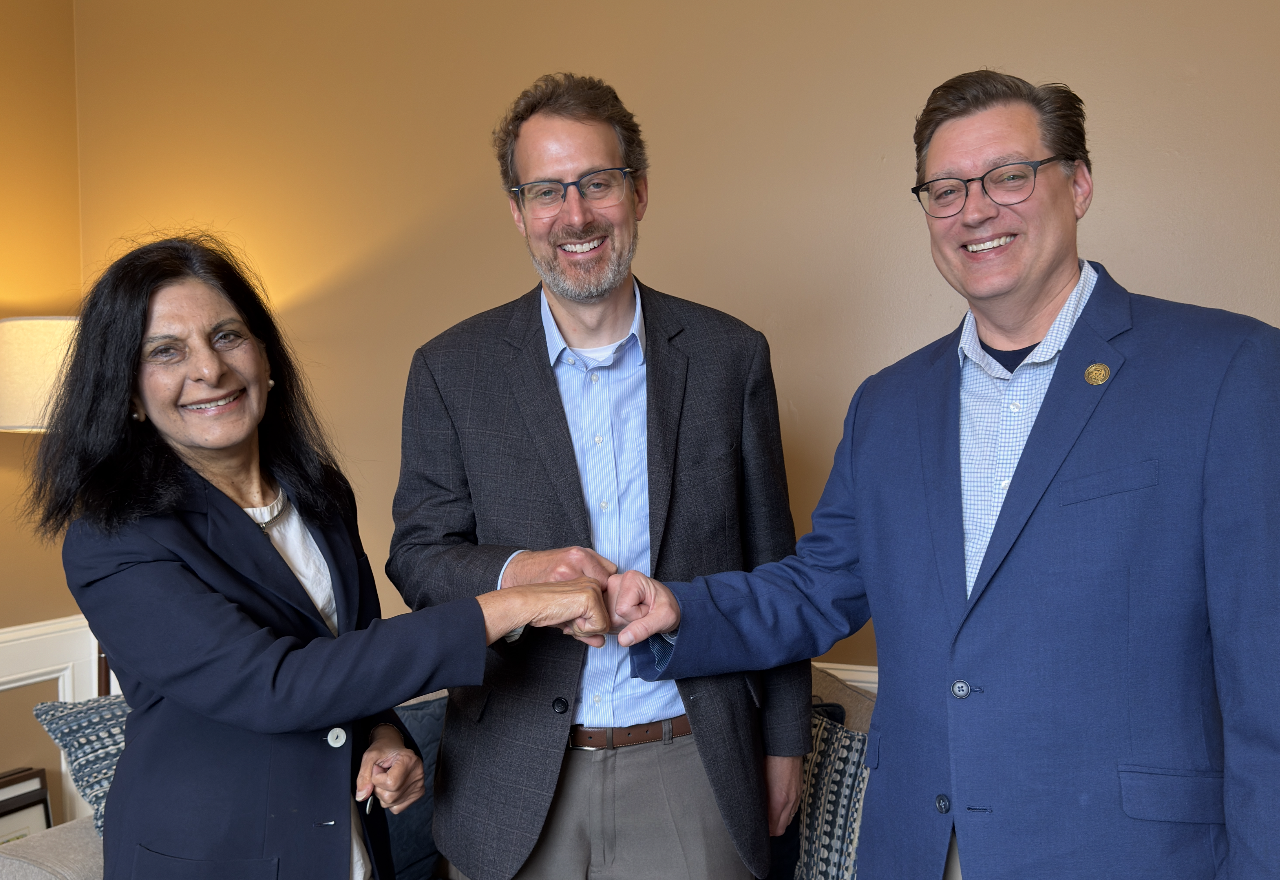
When Commissioner Robert Patrick stepped into Mosaic Health Center in Clarkston, he witnessed something that challenges conventional thinking about healthcare in America: a bustling clinic where healthcare is treated not as a commodity, but as essential infrastructure—as fundamental to a community’s wellbeing as roads and bridges.
“Health care is just like a bridge in a road,” Executive Director Jeremy Cole told the Commissioner during his visit. “You got to have bridges and roads so people can get to work and drive around and trade and do commerce, and you have to have healthy people to do the work.”
A Clinic Born from Gratitude and Need
Mosaic Health Center’s story began 11 years ago with Dr. Gulshan Harjee, who arrived in the United States in 1979 as an asylum seeker from Iran. After building a successful medical practice in Decatur, she saw firsthand what happened when patients lost their insurance—and the devastating impact on both individuals and the healthcare system.
“This is my homage to what this country has offered to me,” Dr. Harjee explained during the Commissioner’s visit. “I arrived here in 1979 … with no formal education in this country, was able to get into med school and have an amazing career, and so this is my way of showing gratitude to this country.”
The need was clear: Clarkston has an uninsured rate of approximately 24%, double Georgia’s state rate, which is already the second-highest in the nation. The clinic serves only the uninsured, intentionally filling a critical gap in Georgia’s healthcare landscape.
Remarkable Growth, Sustained Impact
What began as a volunteer-only operation has transformed into a comprehensive healthcare provider, thanks in large part to Cole’s leadership over the past three years and the ongoing support of community partners, including DeKalb County.
The numbers tell a compelling story:
- From 650 patients annually to 2,000 when Cole joined in 2022
- From a two-day-a-week clinic to six days (Monday through Saturday)
- From 2,000 visits per year to an estimated 6,500-6,700 in the current year
- A staff that collectively speaks 14 languages, serving patients who speak 33 different languages
“The support that the county has given this year is so much to us,” Dr. Harjee noted, emphasizing how county funding helped jumpstart the clinic’s expansion.
Comprehensive Care in a Cramped Space
Despite operating in just 2,000 square feet of rented space, Mosaic Health Center offers remarkably comprehensive services. The clinic provides:
- Primary care with five exam rooms
- An on-site pharmacy dispensing free, same-day medications
- Specialty clinics including cardiology, rheumatology, dermatology, gynecology, psychiatry, vision care, and physical therapy
- State-of-the-art ultrasound imaging
- A wellness program offering nutrition education and cooking classes for diabetic patients
- Partnerships providing free mammograms, colonoscopies, and endoscopies
The Saturday clinic is entirely run by Emory medical students, with about a third of all Emory medical students volunteering with the clinic last year.
The Challenges Ahead
During the conversation, both Dr. Harjee and Cole outlined significant concerns on the horizon. Recent federal legislation is estimated to result in at least 16 million Americans losing health insurance nationally, with projections suggesting 700,000 more Georgians could become uninsured in the coming years.
“Unfortunately, our state’s strategy, I’m sorry to say this, but our state strategy is that we close our eyes and we hope the uninsured don’t get sick,” Cole said. “And that’s not a strategy. It ruins hospitals’ finances and private practices’ finances.”
Dr. Harjee emphasized another critical gap: “Dental is a big, big need. We now know that dental disease is actually reflecting to the whole body, and some of our patients have extremely, extremely poor dental health.” She also highlighted the challenges uninsured women face accessing obstetric care.
Innovation: Meeting Patients Where They Are
One of the clinic’s most innovative proposals is a community paramedicine program, which would deploy trained paramedics to provide primary care in patients’ homes. The need is clear: over 50% of the clinic’s no-shows cite lack of transportation as the reason they couldn’t make their appointment.
“It’s all about access,” Cole emphasized, noting that the program would help keep patients out of emergency rooms while serving those with transportation and mobility challenges.
Commissioner Patrick, who supported county funding for Mosaic Health Center in both 2022 and the current fiscal year, expressed enthusiasm during his visit to the clinic about the approach and discussed potential partnerships, including with school-based health centers and homeless outreach organizations.
Rethinking Healthcare’s Purpose
Perhaps the most powerful moment of the visit came when Cole challenged the fundamental way Americans think about healthcare.
“Health care in this country is seen as a burden. When we talk about health care, we just talk about the cost,” he observed. “But health care is not only not a burden, it’s an opportunity and it’s infrastructure.”
Cole continued with an observation many patients will recognize: “Going to the doctor these days is a five-minute visit with the doctor where they’re typing… It’s about volume. It’s about profit. Healthcare can’t be a business at the end of the day… It’s not a transactional experience. It’s a transformational experience.”
“There’s joy in healing. There’s joy to be healed, and there’s joy to those who heal,” Cole reflected. “We’re just one tiny little clinic in the neighborhood of Clarkston, but that’s what drives us, because maybe the ripples of what we’re doing here can start to change the entire healthcare system in this country, which isn’t working really for any of us.”
A Model Worth Supporting
Commissioner Patrick, himself an immigrant from Canada who entered politics to give back to the country that gave him so much opportunity, understands the importance of what Mosaic Health Center represents. As he noted during the visit, healthcare is similar to water, sewer, and transportation as a critical infrastructure need that can determine where economic growth happens or whether communities can thrive.
In a healthcare landscape often defined by what’s broken, Mosaic Health Center offers a glimpse of what’s possible when compassion, innovation, and community come together—proving that healthcare, at its best, truly is transformational for communities.
For more information about Mosaic Health Center or to support their work, visit their website or contact their office in Clarkston. The clinic continues to seek partnerships with hospitals, foundations, and community organizations to expand their capacity to serve DeKalb County’s uninsured population.